
← Biology Resolution in Action

Case study · MYC · lung cancer

MYC in lung cancer: a network corrected by experiment.

MYC drives many cancers and has no conventional binding pocket. Starting from MYC, the Biology Resolution Agent built a blueprint of its regulatory network, ran one high-content experiment on BioGPU in lung cancer and normal bronchial cells, and corrected the blueprint with what the cells showed.

Category
Target Biology Resolution
Cellular system
A549 lung adenocarcinoma vs NHBE-hTERT normal bronchial epithelium
Experiment
One high-content run · 2 cell models × 5 replicates
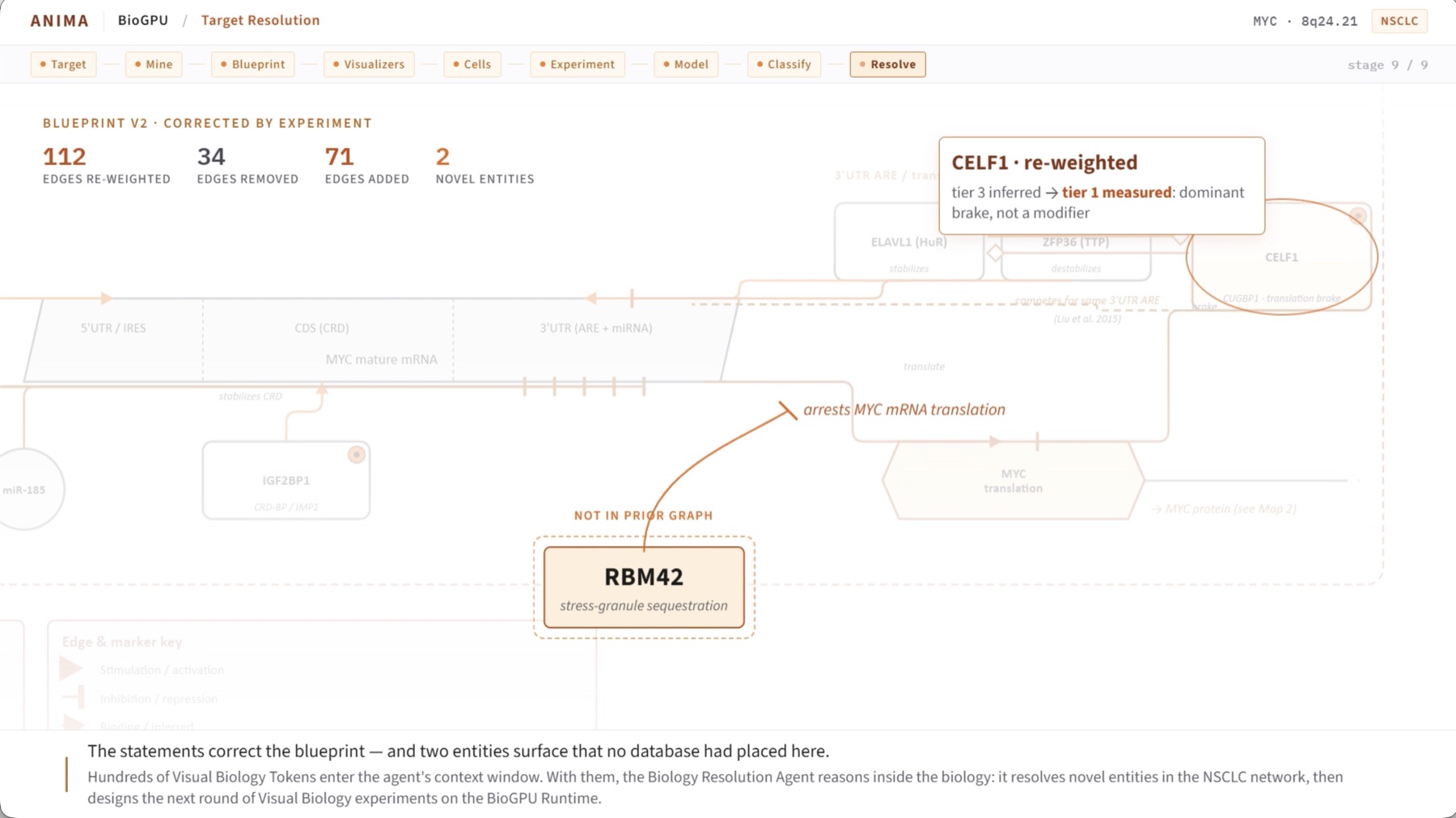
BioGPU runtime, Resolve stage: the MYC mRNA network with CELF1 re-weighted and RBM42 added as an entity not in the prior graph
BioGPU runtime · Resolve stage · the network after the experiment

BioGPU in action

One run, from blueprint to resolved network.

Step through the run as the BioGPU runtime showed it.

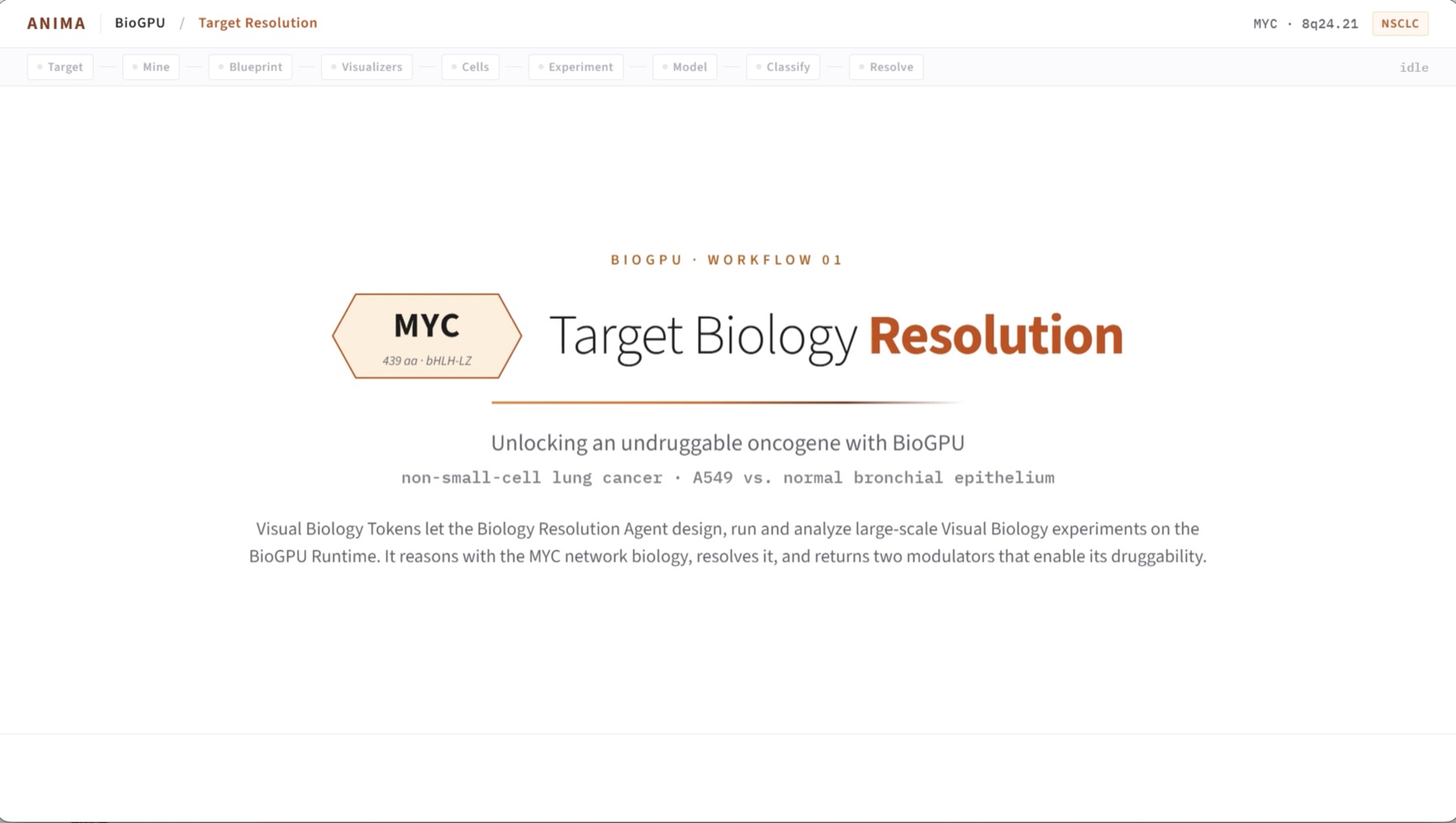
Stage 01 · Target

Unlocking an undruggable oncogene with BioGPU.

Non-small-cell lung cancer · A549 vs normal bronchial epithelium.

    TypeStarting point

    BioGPU runtime, Target stage: MYC, 439 aa, bHLH-LZ, Target Biology Resolution
    BioGPU runtime screen · open full size

    What this demonstrates

    The experiment changed the map.

    The blueprint was the hypothesis. The Visual Biology Tokens from the experiment corrected it.

    112Edges re-weighted
    34Edges removed
    71Edges added
    2Novel entities
    CELF1 · re-weighted

    Phenotypeabundance · 2.8× · p < 1e-9

    CELF1 signal is 2.8× stronger in A549 than in normal bronchial epithelium, and present in essentially every cell.

    InterpretationMore CELF1 on MYC mRNA in disease cells: a translational brake is engaged. In the network it moved from tier 3 inferred to tier 1 measured.

    RBM42 · not in the prior graph

    Phenotypecondensate partitioning · +6.2× foci / cell

    RBM42 concentrates into discrete G3BP1-positive granules in A549 only; the healthy model stays diffuse.

    InterpretationRBM42 partitions MYC mRNA into stress granules, holding the transcript away from ribosomes: a new edge that arrests MYC mRNA translation.

    Shown in this run
    • A target turned into a two-layer regulatory blueprint (mRNA and protein) with visualizer placement.
    • One high-content experiment across matched disease and normal cells.
    • Each visualizer classified by the foundation model and written as Visual Biology Tokens.
    • The blueprint corrected by the evidence, with entities no database had placed.
    What it could inform · not shown here
    • New ways to modulate MYC through regulators of its mRNA and protein.
    • The next round of experiments, designed by the agent from the corrected network.
    • Not shown: that modulating these regulators changes MYC-driven disease, or any compound effect.

    See Phase 1 · Target Biology Resolution → Case study: rheumatoid arthritis →

    Bring us your target.