
Pharma Workflows
Design drugs against your target's cellular network, not just its binding site.
BioGPU shows how your target's cellular network responds to every molecule your AI designs, so that biology guides the next design.
How a program runs
One BioGPU Program Runtime for each target.
Phase 1 sets it up around your target. Phase 2 runs every compound on it.
Connect your AI
Two ways in: run our agent, or plug in your own.
Either way, the experiments run on the BioGPU Runtime and the biology comes back to AI as Visual Biology Tokens.
Anima's Biology Resolution Agent
Runs Anima-built workflows
Your agents
Run your proprietary workflows
Visual Biology Tokens: the images, the biological findings, and their metadata and embeddings, ready for your models and agents.
Phase 1 · Target Biology Resolution
Resolve the cellular network around your target.
Anima's BioGPU Agent runs cellular network experiments in your cellular system until that network is resolved.
The network covers what your program's experiments investigated. Tool compounds reveal network responses; they do not prove direct off-target binding.
Before the first compound
The resolved network already informs your program.
Target, strategy and AI decisions can use it before any compound is tested.
Target decisionsCore
- Disease relevance and causality
- Prioritize or stop a target
Therapeutic strategyCore
- Mechanism and modality
- Resistance and combinations
Your own AICore
- Ground and train models you own on experimental evidence
Translational researchExploratory
- Biomarker hypotheses, pending validation
Phase 2 · Therapeutic Biology Resolution
Compound in. Cellular network effect out.
Every compound your AI designs comes back as its cellular network effect, read against the fingerprint.
- 01 · DesignYour AI designs compound A.
- 02 · RunBioGPU runs it on your Program Runtime.
- 03 · RecognizeIts network effect returns as Visual Biology Tokens.
- 04 · RedesignYour AI designs B, then C, then D.
The same loop for antibodies, small molecules, ADCs, RNA therapeutics, degraders and gene editing →
Biology Resolution in Action
What BioGPU has shown in disease-relevant cells.
Each case study starts from a biological question, shows the experiment BioGPU ran and the evidence it returned.
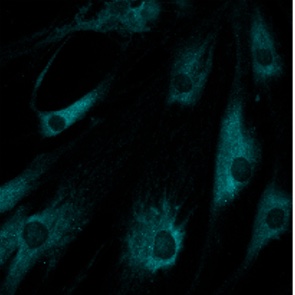
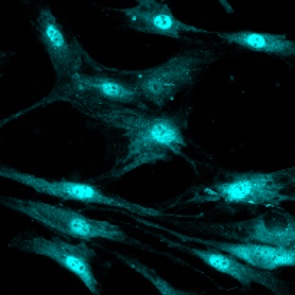
Rheumatoid arthritis, read in patient-derived cells.
Healthy donor vs RA patient fibroblast-like synoviocytes, compared activity by activity.
Open the case study →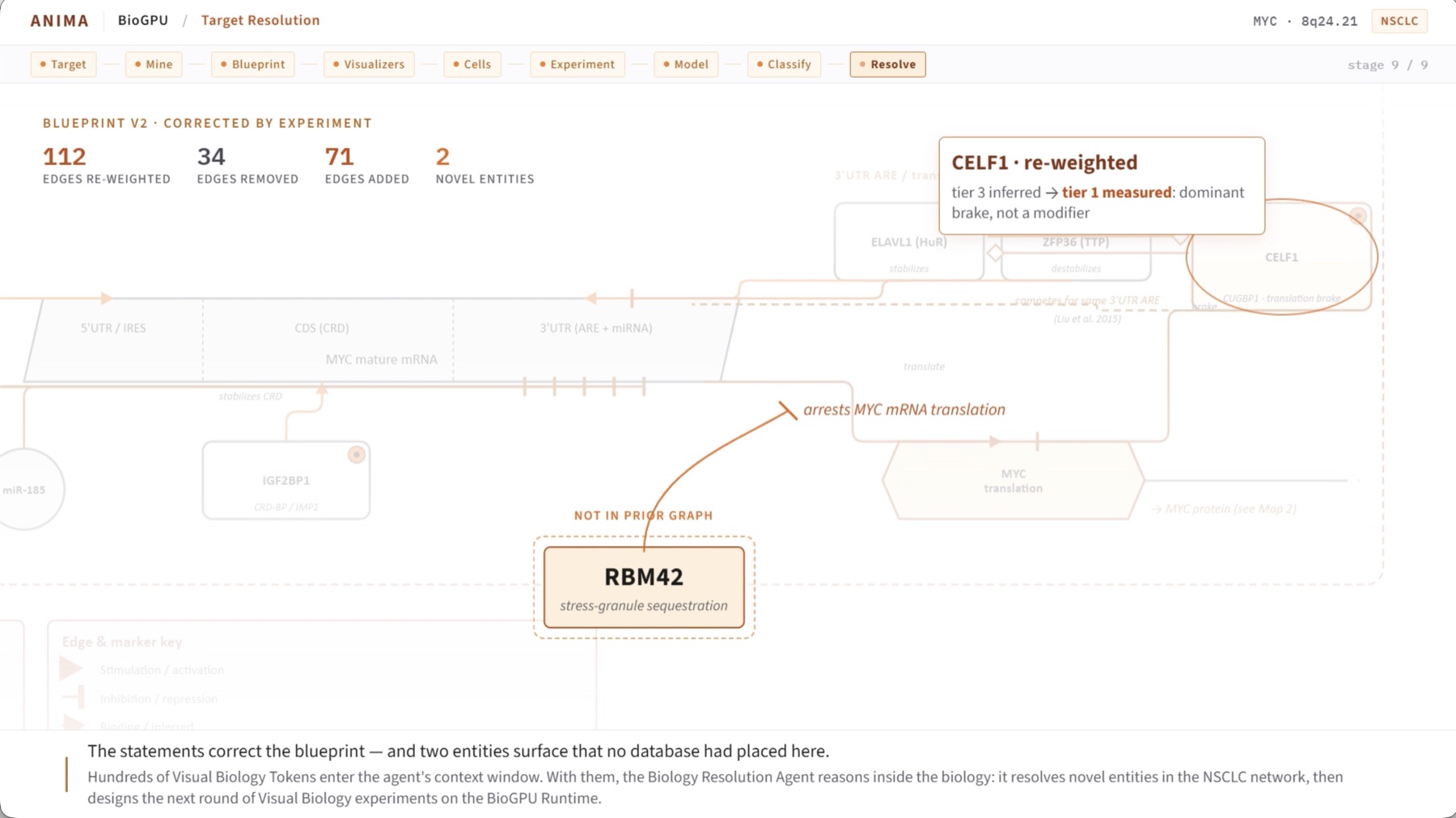
MYC in lung cancer: a network corrected by experiment.
A two-layer blueprint, one high-content experiment in lung cancer vs normal cells, and the map it changed.
Open the case study →Your program
Your program's data and network are yours.
Under your agreement, what your program produces belongs to you. Anima keeps the technology that produced it.
Phase 1 is a defined engagement per target; Phase 2 is recurring capacity, scaled to your throughput.
How it scales
Most of the runtime is shared. Only your target's biology is new.
Bring us your target.
Some targets already have a resolved network, for a faster start. See available targets →